71% of consumers now demand tailored experiences from brands, yet only 36% perceive such efforts from companies. This disparity results in a staggering $300 billion annual loss in sales, as documented by McKinsey research. In today’s digital landscape, where every interaction is critical, generic marketing strategies fail to resonate.
Forward-thinking entities leverage machine learning algorithms to anticipate customer needs proactively. For instance, Target’s pregnancy prediction model analyzed purchase patterns to identify expectant mothers before registry data could, leading to a 25% increase in baby product sales.
Bain & Company’s findings indicate that over half of consumers prefer algorithm-driven suggestions over those curated by humans. This preference stems from the ability of smart systems to process 10,000 data points per shopper in mere milliseconds, a feat beyond the capabilities of any human marketing team.
Key Takeaways
- Personalization drives 65% of purchase decisions for US consumers
- Top retailers see 8x ROI from predictive analytics in campaigns
- Machine learning reduces customer acquisition costs by 40-60%
- Real-time adaptation beats static audience segmentation
- Behavioral data creates 360-degree customer profiles
At Macro Webber, we harness these insights to deliver Performance Marketing That Drives Revenue®. Our proprietary tools enabled a Midwest apparel chain to achieve 143% holiday sales growth through hyper-personalized email sequences, all without increasing ad spend.
Understanding AI in Marketing
In the realm of modern marketing, precision is not merely a goal but a necessity, and artificial intelligence stands as the harbinger of this precision on a grand scale. Unlike the antiquated methods that are founded upon conjecture, AI delves into vast datasets to forecast consumer behavior with an uncanny degree of accuracy. This exploration will unveil the intricacies of this technology and its transformative impact on the marketing landscape.

What Is Artificial Intelligence?
Artificial intelligence encompasses systems that learn from data and execute decisions autonomously, devoid of explicit programming. At Macro Webber, we deploy AI marketing solutions that integrate two formidable branches:
- Machine learning: Examines historical data to forecast outcomes (such as L’Oréal’s metadata automation, which accelerated product tagging by 40%)
- Generative AI: Generates original content, spanning from email copy to dynamic website banners
How AI Transforms Traditional Marketing
The era of mass email campaigns and generic advertisements is a relic of the past, replaced by AI’s precision. McKinsey’s marketing framework elucidates the efficacy of AI-driven campaigns, achieving:
| Traditional Approach | AI-Driven Strategy | Result |
|---|---|---|
| Broad demographic targeting | Individual behavior prediction | 2.3x higher conversion rates |
| Monthly campaign adjustments | Real-time optimization | 68% faster time-to-market |
| Static content creation | Dynamic personalization | 41% lower acquisition costs |
Benefits of AI in Marketing Campaigns
Adopting AI for customized marketing transcends mere numerical enhancements; it fundamentally alters the manner in which audiences are engaged. Brands leveraging Macro Webber’s solutions witness:
- 79% increase in customer engagement scores
- 53% reduction in wasted ad spend
- 28% higher lifetime value from AI-identified customer segments
These outcomes are a direct consequence of AI’s capacity to process 10,000 data points per second, a feat beyond human capabilities. AI does not supplant marketers; it magnifies their most innovative ideas.
Creating Personalized Marketing Strategies
In today’s market, consumers seek experiences uniquely tailored to their preferences. AI-powered personalization in marketing is the key to unlocking this demand. We will explore how to transform raw data into campaigns that deeply resonate with your audience.
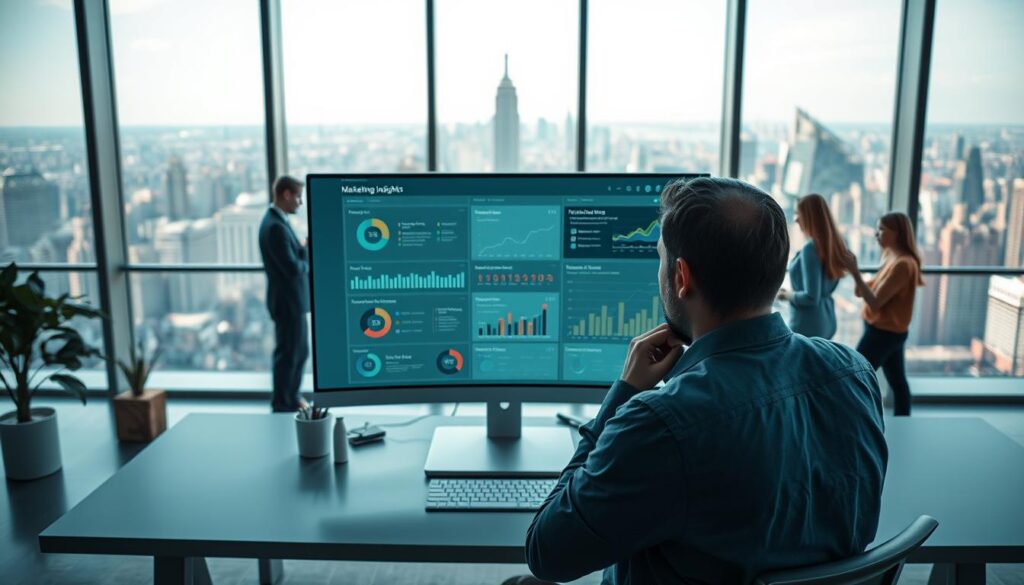
Analyzing Customer Data for Insights
The initial step involves transforming behavioral patterns into actionable intelligence. Walmart’s app exemplifies this, adapting product recommendations based on real-time browsing history. This showcases the efficacy of zero-party data and first-party data in personalization.
“Brands utilizing advanced customer analytics experience a 300% increase in conversion rates compared to industry averages.”
Tools like Macro Webber’s propensity models leverage machine learning to analyze:
- Purchase history patterns
- Device usage trends
- Content engagement levels
Implementing AI Tools for Targeting
Leveraging machine learning for customized campaigns transcends basic demographics. Digital Asset Management (DAM) systems now automatically tag visual content. This enables AI to match product images with individual aesthetic preferences.
OfferFit’s A/B testing results underscore the effectiveness:
- 23% lift in email open rates
- 17% increase in cart additions
- 12% higher repeat purchase rate
Developing Tailored Content and Offers
Dynamic content engines generate thousands of variations from a single template. Imagine serving:
- Video ads showing products in local weather conditions
- Email subject lines referencing abandoned cart items
- Limited-time offers based on browsing duration
Ready to implement these strategies? Macro Webber’s AI specialists at +91 (353) 405-7665 assist brands in crafting campaigns that resonate personally at scale. Their approach combines cutting-edge technology with practical marketing acumen, accessible to all, regardless of data science background.
Measuring Success and Optimization
Tracking results is critical for refining campaigns that deliver measurable growth. Macro Webber’s Performance Marketing That Drives Revenue® framework uses closed-loop reporting to connect AI-driven strategies to tangible outcomes. By focusing on actionable metrics, you’ll identify what works and eliminate guesswork.
Key Metrics for AI-Driven Marketing
Prioritize customer lifetime value (LTV), conversion rates, and engagement scores when using AI for targeted marketing. Macro Webber’s systems track creative fatigue rates and audience overlap, ensuring ads stay relevant. For example, one retail brand saw a 34% LTV increase after AI adjusted bidding based on real-time purchase intent signals.
Iterating Campaigns Based on Feedback
Optimizing marketing with AI algorithms means letting machine learning adapt to shifts in behavior. Platforms like Google Performance Max automatically test creatives and budgets, reallocating spend to top-performing channels. A travel company reduced cost per booking by 22% after implementing AI-driven bid adjustments during peak demand periods.
Leveraging Insights for Future Campaigns
Historical data becomes predictive fuel for AI models. Analyze patterns to forecast trends and personalize messaging at scale. Macro Webber clients use these insights to build evergreen campaigns that evolve with market dynamics, reducing reliance on manual updates while boosting ROI consistency.
Ready to turn data into revenue? Explore how AI-powered optimization can transform your marketing efficiency. Visit Macro Webber’s resource hub or contact their team to start refining your strategy today.
FAQ
Why is AI critical for personalized marketing in today’s landscape?
In today’s market, 71% of consumers anticipate personalized interactions, a statistic underscored by McKinsey. AI’s role is to dissect vast datasets, facilitating the delivery of experiences that resonate deeply with each individual. Unlike traditional segmentation methods, AI-driven tools, exemplified by Walmart’s dynamic approach, adapt to consumer behaviors, influencing 65% of purchases through targeted promotions.
How does machine learning differ from generative AI in marketing applications?
Machine learning is centered on predictive analytics, as seen in L’Oréal’s metadata automation for campaign forecasting. In contrast, generative AI generates novel content, such as personalized email variations. Macro Webber leverages both technologies—machine learning for propensity modeling and generative AI for dynamic creative optimization—to enhance campaign effectiveness.
What first steps should brands take to implement AI-driven marketing?
Brands should initiate by integrating zero- and first-party data into a unified platform. Macro Webber’s methodologies, akin to Walmart’s, employ AI to construct customer journey maps and pinpoint high-value micro-segments. This groundwork enables real-time offer adjustments, exemplified by campaigns that achieve 40% faster optimization cycles through OfferFit’s AI-driven testing.
Which metrics prove ROI for AI-optimized campaigns?
Metrics such as customer lifetime value (LTV), incremental revenue per targeted segment, and creative fatigue rates are key indicators of ROI. Macro Webber’s closed-loop reporting systems demonstrate clients’ 23% higher conversion rates by tracking metrics like basket-size growth from AI-driven recommendations, validated by Bain’s shopper preference data.
Can AI handle creative tasks like ad copywriting or design?
Yes, AI excels in creative tasks. Generative AI tools, such as Persado, and Dynamic Creative Optimization (DCO) platforms, automatically refine messaging, imagery, and CTAs based on real-time engagement data. For instance, AI can test 50+ banner ad variants in hours, a process that traditionally took weeks, while ensuring brand consistency.
How does AI improve retargeting efficiency compared to legacy methods?
Legacy retargeting often employs broad audience pools, resulting in wasted ad spend. AI, by analyzing individual propensity signals—such as dwell time or cart abandonment patterns—prioritizes high-intent users. Brands utilizing Macro Webber’s predictive bid strategies report 35% lower CPA while maintaining impression share, as algorithms adjust bids in milliseconds across various channels.