
Skip to content

WEBSITES & CONVERSION

A better first impression.
A clearer next step.

Give visitors a reason to stay, trust your business and get in touch. We bring structure, content, design and the enquiry journey together—whether you need a focused improvement or a new website.

20 minutes. One real challenge. Meeting subject to confirmation.

Help a visitor understand, trust and act.Understand the offer: Clear service information. Assess the evidence: Relevant, credible proof. Take the next step: Simple forms & bookings01Understand the offerClear service information02Assess the evidenceRelevant, credible proof03Take the next stepSimple forms & bookings
Help a visitor understand, trust and act.A visual summary of the website decision journey.
Evidence you can inspect. Client identities protected.Explore 18 report-backed case summaries ↗

SEE THE CONNECTION

Make the page answer the buyer’s questions

A practical framework for your business.
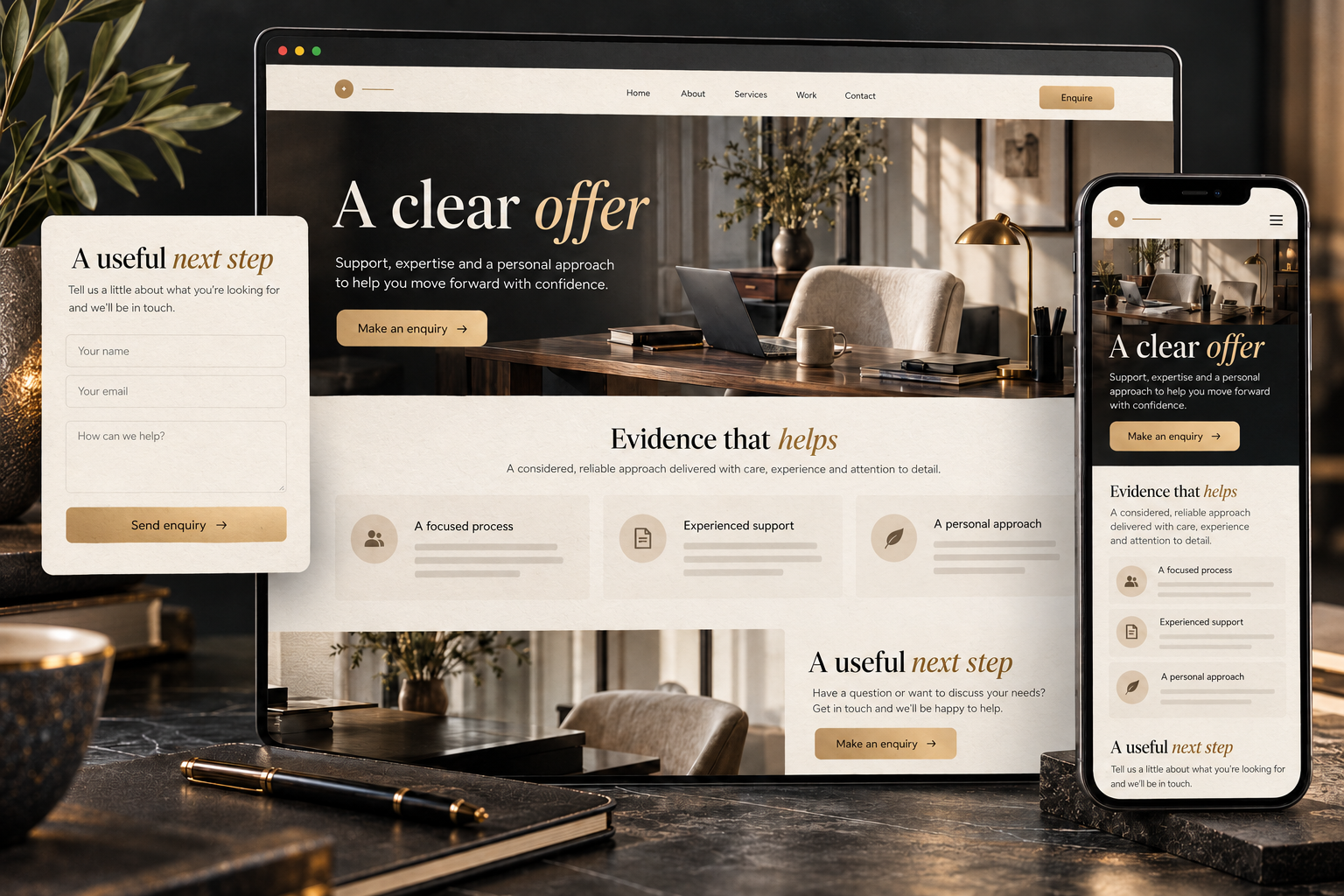
Illustrative responsive website shown on desktop and mobile, with evidence and an enquiry form.

Illustrative scene and interface, not client evidence. View image ↗

  1. 01

    What is it?

    Lead with the offer and who it helps.

  2. 02

    Why trust it?

    Show relevant evidence and practical detail.

  3. 03

    What next?

    Give visitors a clear, usable action.

THE STARTING POINT

Visitors arrive, compare their options, then leave because the offer or next step is unclear.

We clarify the message, improve the path to enquiry and remove practical friction. Sometimes that needs a new website. Often it starts with improving what you have.

What we look at first

  • What a first-time visitor can understand in the opening screen.
  • Whether the content answers the questions people ask before enquiring.
  • The mobile journey, speed, forms and practical friction in the next step.

THE WORK

A focused scope.
Connected to the problem.

What we include depends on your starting point. These are the parts we can bring together.

Building something new?

Start with the audience, page structure and content. Agree the design direction before implementation.

Improving an existing website?

Keep what works. Identify the pages and decision points that create friction, then prioritise focused changes.

Before work starts, agree the pages, content responsibilities, revision process, measurement and handover requirements.

01

Structure and message

Build a clear path from the customer’s problem to the offer, supporting evidence and the next action. The navigation and page hierarchy should make sense to the person buying.

02

Design and experience

Use layout, typography and interaction to make the business credible and the page easy to use. Visual quality should support understanding on both a phone and a larger screen.

03

Conversion improvement

Review the decision points that influence enquiries: offer clarity, proof, calls to action and form friction. Agree what to test and what a meaningful improvement would look like.

04

Implementation and measurement

Connect the site to the systems needed for enquiries, booking and measurement. Check the handoff so a successful form interaction becomes something the team can act on.

FOLLOW THE JOURNEY

Design for the whole enquiry route

A practical framework for your business.

  1. 01

    Screen

    Readable content and usable controls on a phone.

  2. 02

    Form

    Only the details needed for a useful response.

  3. 03

    Response

    A tested destination and an accountable owner.

From page plan to handover

Know what the website project includes.

A stronger service page or simpler enquiry path may solve the problem before a rebuild is needed.

01

Page and content blueprint

Agree the audience, page hierarchy and enquiry route. Identify approved service information, authentic proof, imagery and content responsibilities before design begins.

02

Responsive build and review

Define pages or templates, mobile behaviour and revision rounds. Review staging before release, and establish the scope of browser, device and accessibility checks.

03

Enquiry and launch checklist

Specify forms, booking destinations, response owners and measurement events. Validate receipt separately from a visible success message, then agree handover and support.

Before you decide

A few practical answers.

Do we need a complete rebuild?

Not necessarily. We first assess whether the current site can support the required changes. The scope may be a page improvement, a landing page or a rebuild; it should address the real constraint.

What is included in the website fee?

The proposal defines pages, revisions, integrations, measurement and handover, plus responsibilities for content, hosting, licences and maintenance. Your team provides approved business information, authorised imagery and legal text.

Will a new design guarantee more enquiries?

No. Enquiries also depend on traffic quality, the offer and follow-up. Where data is available, agree conversion definitions, a baseline and a review period. A visual review alone cannot establish an uplift.

MAKE THE NEXT DECISION

A website project has a life after launch

A practical framework for your business.

  1. 01

    Build

    Agree pages, content and integrations.

  2. 02

    Validate

    Check devices, forms and essential tracking.

  3. 03

    Maintain

    Clarify ownership, access and ongoing care.

Digital experience and delivery

A website is an operating asset.

A premium website must help buyers understand the offer and help your team handle what follows. Agree the content, decision paths and ownership alongside the design.

01

Plan the information

Map customer questions, service detail, proof and the main enquiry routes. Retain useful existing content and identify gaps that subject-matter experts need to fill.

02

Test the complete journey

Check key pages, forms, calls and bookings across representative screen sizes. Review keyboard use, readable text and clear error feedback alongside appearance.

03

Prepare the handover

Agree content approvals, integrations, analytics, access and maintenance responsibilities. Launch criteria should cover real enquiries and practical use by the operating team.

THE FIRST CONVERSATION

One page.
A better decision.

Share your URL and the action you want visitors to take. We will discuss where the message, evidence or experience needs work before deciding whether a rebuild makes sense.

20-minute review. Meeting subject to confirmation. No commitment to a package.

  • Bring the contextYour website or profile, who you serve and the opportunity you want to improve.
  • Choose one challengeWhat is getting in the way, what you have tried and what you can already measure.
  • Leave with directionA clearer question, a sensible first priority and whether it is useful to explore working together.