A network-wide average can hide an inaccurate profile, weak location page or slow response at an individual branch.
By Macro Webber · General business guidance, not a client case study.
Where local interest can lose its way.Check the information and the receiving team.
SEE THE CONNECTION
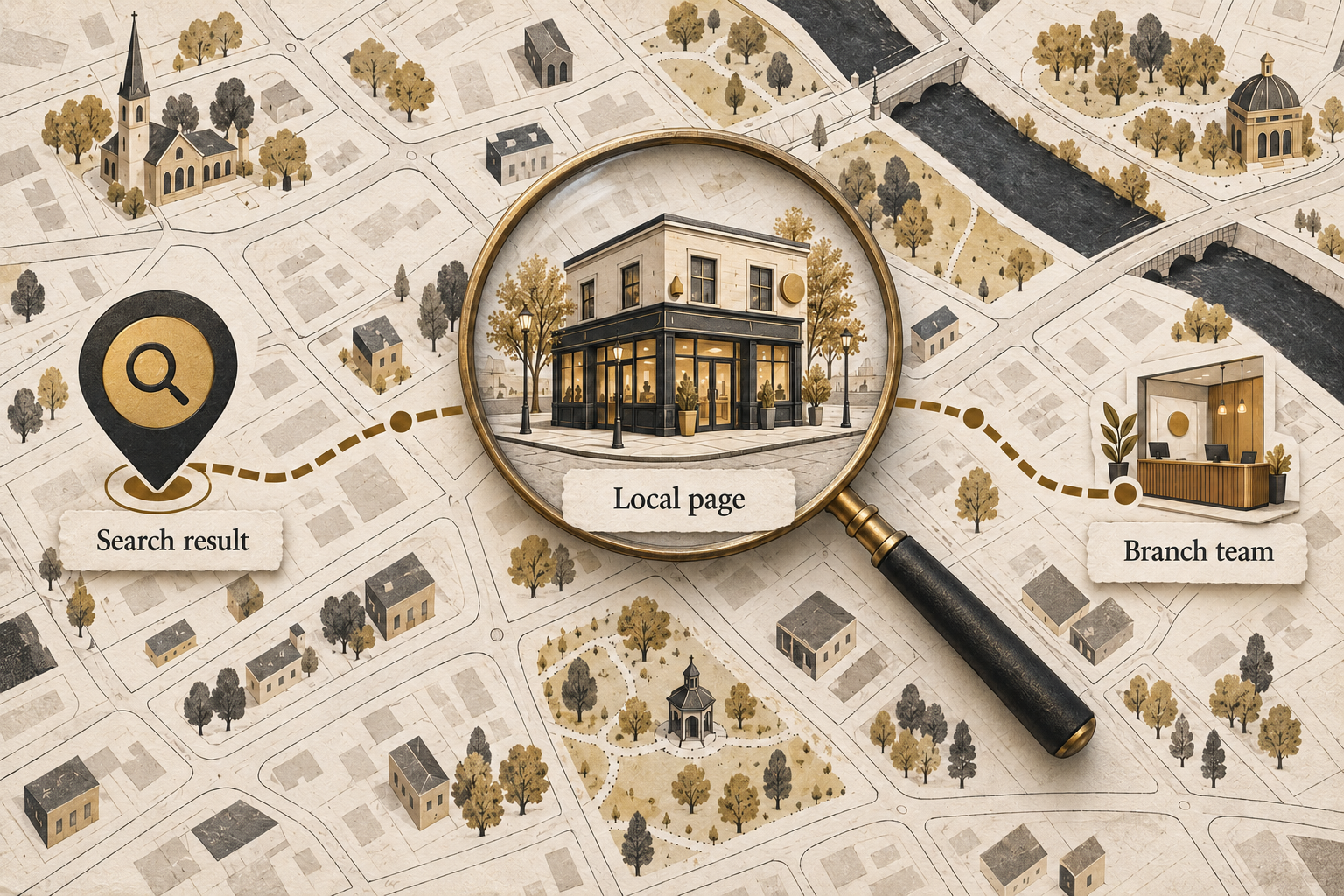
The local journey has three connected destinations
A practical framework for your business.
Original illustrative artwork, not client evidence. View image ↗
01
Search result
Accurate business information in the relevant area.
02
Local page
A service and location page that matches the query.
03
Branch team
A working contact route to an accountable owner.
01
Check the customer’s actual destination
Confirm branch names, hours, services, address or service area and contact routes. Look for duplicate or outdated profiles and links that send every visitor to a generic homepage. Only represent genuine locations and eligible service areas.
02
Inspect a local journey on a phone
Follow a relevant local search to the profile, location page and enquiry action. Check that directions and contact details match. Ask whether a visitor can understand what this branch offers and reach the right team without navigating the whole network.
FOLLOW THE JOURNEY
A fair comparison needs shared ground
A practical framework for your business.
01
Period
Use matching windows and seasonal context.
02
Operation
Account for hours, services, maturity and capacity.
03
Definition
Count the same type of action in every branch.
03
Compare branches fairly
Separate new locations building awareness from established branches losing demand. Account for catchment, competition, capacity, spend and seasonality. A quieter branch may be short of staff or appointments rather than simply missing visibility.
04
Review handling, not just visibility
Assign an enquiry owner and a fallback when a local team is unavailable. Compare actual enquiries, response times and qualified opportunities where records permit. A directions request or call-button click is not proof that the customer arrived or bought.
MAKE THE NEXT DECISION
Find a gap your team can change
A practical framework for your business.
01
Inspect
Walk through one journey on a phone.
02
Assign
Give the correction to a clear local or central owner.
03
Retest
Verify the route and review comparable evidence.
05
Test one useful improvement first
Choose a branch with a clear gap and a team able to act. Correct information, improve a page or repair routing, then observe the agreed measures. Learn from the pilot before applying the same change to every location.
Apply this guide
Compare branches on a consistent basis.
Published by Macro Webber. Use the framework with central and local teams so the profile data can be interpreted alongside capacity, service coverage and received enquiries.
01
Verify the information first
Confirm the branch hours, phone, location and services. Incorrect information can distort both customer experience and performance comparisons.
02
Account for local conditions
Compare equivalent periods and consider seasonality, catchment, operating capacity and competing locations before ranking branches.
03
Test the route to the branch
Follow calls, forms and bookings through to the receiving team. Profile views and direction requests do not by themselves establish customers or completed visits.
THE FIRST CONVERSATION
Compare the locations. Understand the difference.
Choose two branches with different results. We will discuss what customers see, where enquiries arrive and the context the network-wide average may be missing.