
Skip to content

ANALYTICS & MEASUREMENT

Fewer reporting doubts.
Better business decisions.

See what happens after the click. Define meaningful actions, check the tracking and connect available enquiry feedback so your report helps you decide what to improve next.

20 minutes. One real challenge. Meeting subject to confirmation.

Different events. A connected view.Record the action: Calls, forms & bookings. Check the opportunity: Received & qualified. Inform the decision: Outcome & context01Record the actionCalls, forms & bookings02Check the opportunityReceived & qualified03Inform the decisionOutcome & context
Different events. A connected view.Keep actions, opportunities and outcomes distinct.
Evidence you can inspect. Client identities protected.Explore 18 report-backed case summaries ↗

SEE THE CONNECTION

Follow one enquiry through the business

A practical framework for your business.
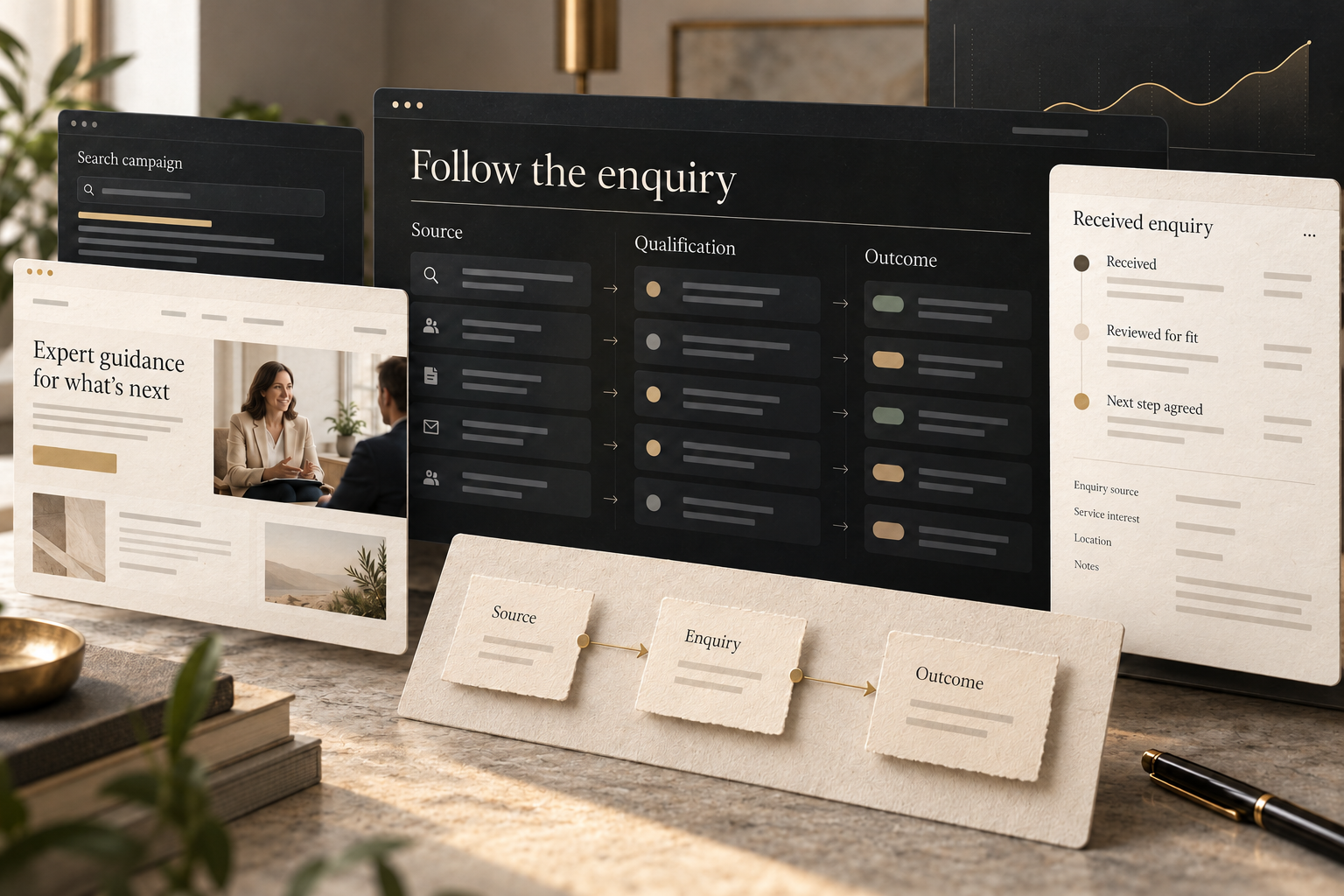
Illustrative campaign and enquiry interfaces connecting source, qualification and outcome.

Illustrative scene and interface, not client evidence. View image ↗

  1. 01

    Source

    Where did the enquiry originate?

  2. 02

    Qualification

    Was it suitable and successfully received?

  3. 03

    Outcome

    What happened after the initial response?

THE STARTING POINT

Reports show activity, but cannot explain which work brings useful demand.

We agree definitions, check tracking and connect available marketing and sales data. Reporting separates what is measured, what is inferred and what remains unknown.

What we look at first

  • Which actions are being counted and whether the definitions are consistent.
  • Where source information is lost between marketing, enquiries and sales.
  • Whether the reports answer a decision your business actually needs to make.

Measurement your team can interpret

Know what happened after the click.

A dashboard is useful only when its events mean something. Define an enquiry, test the tracking and show where marketing data stops short of a qualified lead or sale.

01

Measurement specification

Map business questions to events, parameters and sources. Distinguish clicks, successful submissions, completed bookings and qualified leads; identify the owner of each source.

02

Tracking validation record

Test agreed journeys for event firing, duplicates, campaign tagging and cross-domain handoffs where applicable. Record observed results, consent limitations and fixes needing platform access.

03

Decision-ready reporting

Define metrics, source-of-truth rules and review questions. Make missing CRM outcomes, attribution differences and gaps visible rather than claiming full revenue measurement.

FOLLOW THE JOURNEY

Three numbers, three different questions

A practical framework for your business.

  1. 01

    Platform action

    A click or tracked interaction.

  2. 02

    Received enquiry

    A real contact received by the business.

  3. 03

    Confirmed outcome

    A verified sale, booking or agreed endpoint.

MEASUREMENT

Decide what success
should look like.

Qualified demand, acquisition costs and contribution where the underlying data supports it.

We agree a baseline, definitions and a review period before drawing conclusions. The market, the offer and the handoffs around the work all affect the outcome.

We start with the decisions that are currently hard to make. If the business cannot tell whether a channel is worth the spend, we trace the available data from that channel through the enquiry and sales process. The gap determines the work.

Illustrative measurement plan

A clearer funnel, without invented figures.

A reporting outline—not a client dashboard or verified result.

01

Enquiry: submission received

Use a verified successful submission or booking record, not an outbound button click. Check duplicates and failures before counting it.

02

Qualified opportunity: fit reviewed

Use a consistent CRM status set by the responsible team. Record suitability, source where available and the reason for exclusion.

03

Business outcome: independently recorded

Join booked work or sales records where permissions and systems allow. State the reporting period, attribution model and gaps alongside every conclusion.

Before you decide

A few practical answers.

Can you prove which channel caused every sale?

No. Consent, device changes, offline activity and attribution rules create gaps. We explain the model and connect CRM outcomes where feasible, rather than claiming complete attribution.

What is included in the measurement scope?

The proposal defines properties, event journeys, tag changes, dashboard views and validation. CRM integrations, server-side tracking, consent-platform changes, connectors and ongoing reporting are separately specified where needed.

Who owns access, consent and data quality?

Your business provides authorised access, approves consent requirements with appropriate advice and assigns sales-data owners. We agree the technical implementation and checks. Analytics setup alone does not establish compliance or correct missing records.

MAKE THE NEXT DECISION

A reporting system your team can use

A practical framework for your business.

  1. 01

    Define

    Agree event names and owners.

  2. 02

    Validate

    Test tracking against known actions.

  3. 03

    Decide

    Connect the evidence to one business decision.

Decision-ready measurement

A shared definition before a shared dashboard.

Leadership, marketing and sales can read the same number differently. Agree what is being counted, where the data comes from and which decision it should inform.

01

Define the measures

Document events, source systems, conversion definitions and reporting periods. Keep recorded activity, received enquiries, qualified opportunities and completed sales separate.

02

Validate the journey

Test tracking from the customer action to the receiving system. Check duplicate counts, missing sources and reconciliation with the team handling the enquiry.

03

Report the uncertainty

Explain attribution limits, data gaps and changes to measurement. A useful review pairs the numbers with context and a clear next decision.

THE FIRST CONVERSATION

Start with one number.
Make it useful.

Bring a report and the business question it should answer. We will discuss the definitions, tracking checks and missing context that would make it easier to act on.

20-minute review. Meeting subject to confirmation. No commitment to a package.

  • Bring the contextYour website or profile, who you serve and the opportunity you want to improve.
  • Choose one challengeWhat is getting in the way, what you have tried and what you can already measure.
  • Leave with directionA clearer question, a sensible first priority and whether it is useful to explore working together.