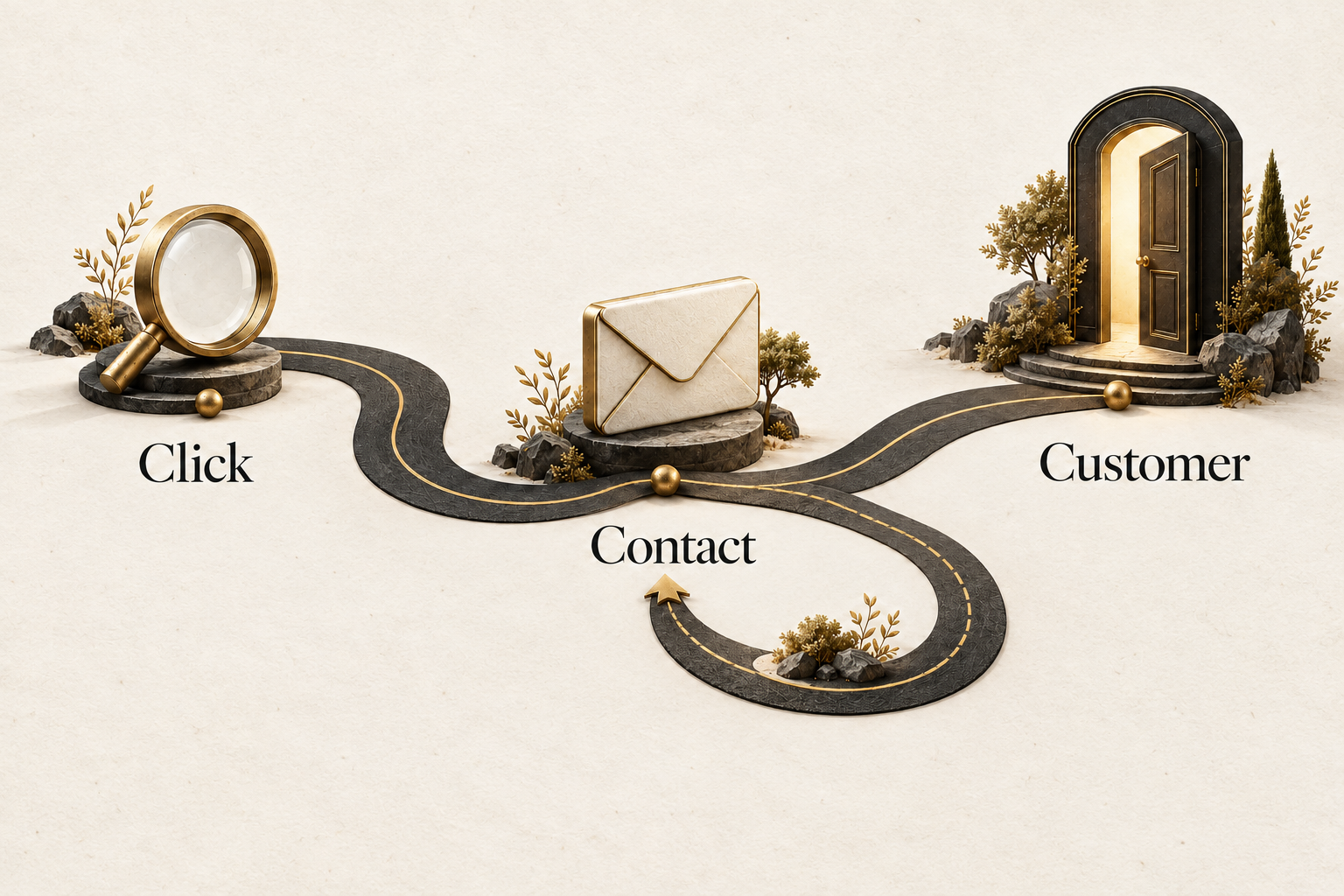
Traffic is an input. To decide whether marketing is useful, follow what happens after the visitor takes the next step.
By Macro Webber · General business guidance, not a client case study.
A click, an enquiry and a customer are different.Track each handoff; do not equate the counts.
SEE THE CONNECTION
Follow the enquiry, not just the click
A practical framework for your business.
Original illustrative artwork, not client evidence. View image ↗
01
Click
A platform records an interaction.
02
Contact
The business receives a genuine enquiry.
03
Customer
A confirmed commercial outcome may follow.
01
Define the next step precisely
A booking-button click, successful form submission and completed appointment are different events. Name the action you want, identify its source of truth and document what the tracking system can actually observe. Do not call an outbound click a completed booking.
02
Validate before comparing
Use controlled tests to check event firing, duplicates and failure states. Compare website submissions with the receiving system. A visible success message proves only that the page displayed a message; it does not establish inbox, CRM or calendar receipt.
FOLLOW THE JOURNEY
Every stage needs its own definition
A practical framework for your business.
01
Event
Name exactly what the tracking counts.
02
Qualification
Agree what makes an enquiry suitable.
03
Outcome
Identify a verified endpoint and its source.
03
Add qualification feedback
Give the team handling enquiries a consistent way to record fit and outcome. Separate unsuitable, duplicate or unreachable contacts from genuine opportunities. Review patterns by source without pretending every offline conversation can be attributed perfectly.
04
State what the report cannot tell you
Consent choices, device changes, delayed sales and different platform attribution rules all create gaps. Record the reporting period, model and missing sources. Comparing dashboards with different definitions can create an apparent disagreement rather than a real performance problem.
MAKE THE NEXT DECISION
Use the report to make a bounded decision
A practical framework for your business.
01
Reconcile
Compare tracked actions with known received contacts.
02
Explain
State gaps, time lags and attribution limits.
03
Improve
Choose one change the evidence can support.
05
Make one actionable decision
Use the evidence to decide whether to improve the offer, page, targeting or response process. Define the change and observation period before testing. More clicks alone are not a reason to increase spend if the team is not receiving suitable opportunities.
Apply this guide
Turn a conversion report into a better business question.
Published by Macro Webber. Use this framework with your marketing and sales teams, keeping the source data and the people handling enquiries in the same conversation.
01
Choose a consistent period
Match traffic, enquiry and sales windows where practical. Record changes in tracking or offer availability that affect the comparison.
02
Reconcile the handoff
Compare recorded forms and calls with what the business actually received. Check duplicates before interpreting a rise in reported conversions.
03
Review quality and timing
Use qualified opportunities and completed sales alongside response time and sales-cycle length. Attribution can be incomplete, especially when several channels contribute.
THE FIRST CONVERSATION
Follow one enquiry. Find the missing context.
Bring a report and the enquiry journey it is meant to describe. We will discuss what it counts, what your team receives and which feedback would make the next decision clearer.