
Skip to content

AI & AUTOMATION

Less repetitive work.
More room to grow.

Enquiries should start conversations, not another round of copying and chasing. Connect the predictable steps around your team, with clear ownership and a person ready for the exceptions.

20 minutes. One real challenge. Meeting subject to confirmation.

A useful workflow keeps people in control.Capture once: Enquiry & context. Route deliberately: People & systems. Review exceptions: Human control & fallback01Capture onceEnquiry & context02Route deliberatelyPeople & systems03Review exceptionsHuman control & fallback
A useful workflow keeps people in control.A simplified workflow with a human review point.
Evidence you can inspect. Client identities protected.Explore 18 report-backed case summaries ↗

SEE THE CONNECTION

A useful automation has a human route

A practical framework for your business.
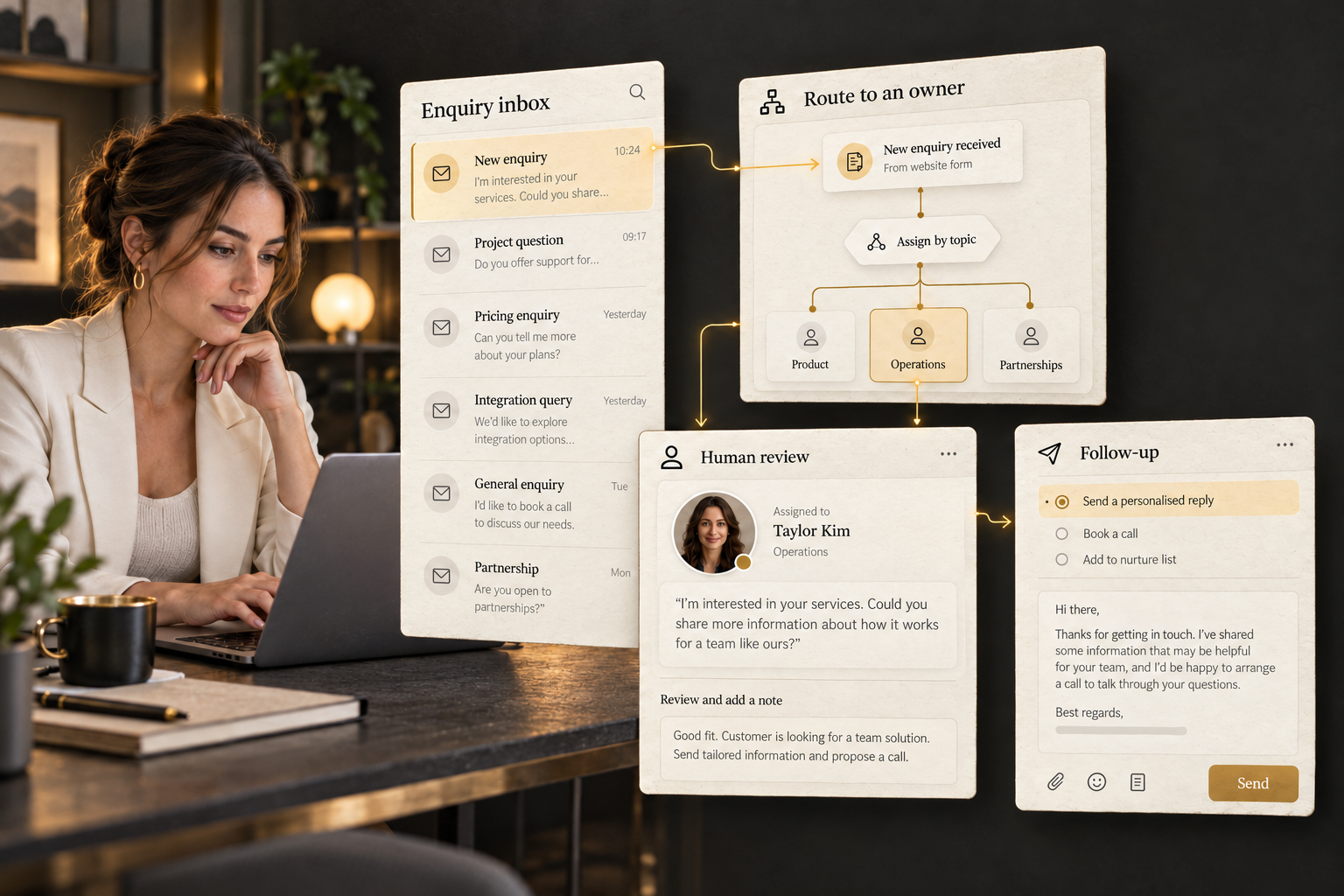
Illustrative enquiry workflow showing an inbox, owner assignment, human review and follow-up.

Illustrative scene and interface, not client evidence. View image ↗

  1. 01

    Trigger

    One clear event starts the workflow.

  2. 02

    Defined action

    An agreed rule handles a repeatable task.

  3. 03

    Exception owner

    A person handles uncertainty or failure.

THE STARTING POINT

Your team copies information between systems while enquiries wait for a response.

We map the process, automate predictable steps and agree where a person must review or take over. AI is useful only when the task, data and safeguards fit.

What we look at first

  • Where information is copied between forms, inboxes, spreadsheets and CRM systems.
  • Which decisions are predictable and which require judgment or review.
  • What should happen when a workflow fails, data is missing or a customer needs a person.

Practical workflows with human control

Automate a defined task, not an undefined problem.

Start with a repeatable handoff: capturing an enquiry, routing it to the right person or preparing a follow-up draft. Decide where rules are enough and where a person must stay in control.

01

Workflow and data map

Document the trigger, required inputs, systems and owner of each step. Identify permissions, sensitive data and missing information before selecting tools or sending data to an AI provider.

02

A bounded pilot

Define one workflow, representative test cases and acceptance checks. Agree approval gates, incomplete-input handling and the fallback to a person.

03

Operating and handover guide

Set out monitoring, failure alerts, account ownership and manual recovery. Record dependencies and agree who maintains the workflow when services or business rules change.

FOLLOW THE JOURNEY

From repeated admin to a controlled handoff

A practical framework for your business.

  1. 01

    Capture once

    Use only the information the process needs.

  2. 02

    Route clearly

    Send the work to its agreed destination.

  3. 03

    Review exceptions

    Keep a visible route to human judgement.

Illustrative workflow—not a live integration

A trigger. An owner. A safe exception route.

This outline shows the controls a pilot needs. It does not claim a client deployment or measured time saving.

01

Capture and check

A website enquiry arrives. Validate required fields, keep source information and flag incomplete or sensitive submissions for a person.

02

Route and prepare

Assign the enquiry using agreed service or branch rules. Prepare a response draft where useful; require human approval before sending if that is the agreed control.

03

Monitor and recover

Record handoff status, notify the owner of failures and keep a manual route available. Do not silently discard exceptions or repeatedly send the same response.

Before you decide

A few practical answers.

Will AI send messages without approval?

Only when that specific action is explicitly agreed and tested against approved rules. Customer-facing drafts and consequential actions can require human review. Every workflow needs an owner and an uncertainty or failure fallback.

What are the ongoing costs and responsibilities?

The proposal separates discovery, build and support from subscriptions, API usage and messaging charges. Agree account ownership, limits, monitoring and maintenance before launch; ongoing support is not automatically included.

Can you connect every system and guarantee savings?

No. Feasibility depends on APIs, permissions, data quality and provider limits. We check dependencies and compare pilot performance with your baseline. Sensitive data needs approved handling rules.

MAKE THE NEXT DECISION

Know the boundary before the pilot starts

A practical framework for your business.

  1. 01

    Access

    Limit data and system access to the task.

  2. 02

    Approval

    Identify decisions that need a person.

  3. 03

    Recovery

    Agree logs, fallback and stop conditions.

Controlled implementation

Automate a process you can explain.

For established operations, an automation has to fit the systems, people and exceptions around it. A contained pilot should clarify the process and the controls before wider rollout.

01

Map the boundaries

Record the trigger, approved inputs, destination systems and people responsible for the outcome. Identify sensitive information and unnecessary data movement.

02

Keep review and fallback

Define which decisions require a person, how failures are surfaced and what happens when an integration is unavailable or an output is uncertain.

03

Evaluate actual use

Compare the pilot with a measured baseline, including exceptions, maintenance and human review. Expand only when the operating team can manage the workflow responsibly.

THE FIRST CONVERSATION

Bring the busywork.
Find a useful first pilot.

Choose one repetitive task and the tools involved. We will discuss what could be simplified, what needs a person and how a small pilot could be judged.

20-minute review. Meeting subject to confirmation. No commitment to a package.

  • Bring the contextYour website or profile, who you serve and the opportunity you want to improve.
  • Choose one challengeWhat is getting in the way, what you have tried and what you can already measure.
  • Leave with directionA clearer question, a sensible first priority and whether it is useful to explore working together.